Quick answer
Most window cleaning businesses need general liability insurance first, since it covers injuries to clients and damage to their property. Add workers' compensation if you have employees and your state requires it, commercial auto if you drive to jobs, and tools and equipment coverage for ladders and water-fed systems. Commercial contracts may also require additional insured endorsements, set limits or an umbrella policy.
In this guide
- What insurance does a window cleaning business need?
- Window washing business insurance at a glance
- How much does window cleaning insurance cost?
- Is workers' comp required for window cleaners?
- Working at height: OSHA rules and your insurance
- Contracts, certificates and additional insured requests
- Common gaps in window cleaning coverage
- Checklist: what to ask an agent or check in a contract
Window cleaning insurance is usually a bundle of policies, not one product. Most window cleaning businesses start with general liability (insurance that pays if your work injures someone or damages their property). From there, they add workers' compensation if they have employees, commercial auto for work vehicles, and coverage for ladders, poles and water-fed systems. What you actually need depends on your state, your crew, how high you work and what your client contracts require.
What insurance does a window cleaning business need?
Window cleaning puts ladders, water and glass right next to other people's property. A few coverages are close to standard in this trade, and a few more are worth a look as you grow.
General liability. This is the base policy. It covers claims from people outside your business, like a homeowner who slips on soapy water or a ladder that cracks a pane. ERGO NEXT notes that many clients ask for proof of insurance, usually general liability, before they hire a cleaning service. The guide to general liability insurance for a cleaning business goes into more detail.
Workers' compensation. This pays medical bills and part of lost wages when an employee gets hurt on the job. Most states require it once you have employees, but the rules differ. You'll find examples in the workers' comp section below.
Commercial auto. If you drive to jobs with ladders on the roof, your personal auto policy may not pay for an accident. ERGO NEXT says business-owned vehicles and personal vehicles you drive for work typically need commercial auto insurance.
Tools and equipment coverage. Ladders, poles, water-fed systems and pure-water units get expensive fast. The Hartford describes commercial property insurance as helping protect your building plus the tools, equipment and supplies you use. Gear that travels from job to job is often insured under "inland marine" coverage (a policy for property that moves around).
Business owner's policy (BOP). The Hartford says many window cleaning businesses start with a BOP as the foundation of their plan. The U.S. Small Business Administration describes a BOP as a package that combines typical coverage options into one bundle.
For a wider view of how these pieces fit together across the cleaning trades, see the overview of business insurance for a cleaning business.
Window washing business insurance at a glance
Policy wording varies by insurer and state. Treat this table as a guide to what to ask about, not a promise of what any single policy includes.
| Coverage type | What it generally covers | What it usually excludes | Who typically needs it |
|---|---|---|---|
| General liability | Injuries to clients or the public, damage to their property, related legal costs | Injuries to your own employees, your own tools, vehicle accidents | Nearly every window cleaner, solo or crew |
| Workers' compensation | Employee medical care and part of lost wages after a work injury | Independent contractors who are truly independent; owners in some states unless added | Businesses with employees, based on state law |
| Commercial auto | Accidents in vehicles used for work | Tools and gear stored in the vehicle | Anyone driving to jobs, especially with a business-owned truck or van |
| Tools and equipment (inland marine) | Theft or damage to ladders, poles and water-fed systems at jobs or in transit | Normal wear and tear; sometimes theft from an unlocked vehicle (check wording) | Owners with valuable gear |
| Business owner's policy | General liability plus property in one package | Auto, workers' comp | Small, lower-risk businesses that qualify |
| Commercial umbrella | Extra liability limits above other policies | Anything the underlying policies do not cover | Crews doing commercial or high-value work, or with contracts that ask for higher limits |
| Janitorial bond | Pays a client if an employee steals from them | Your own losses; it is not a liability policy | Residential crews working inside homes |
How much does window cleaning insurance cost?
There's no single price. MoneyGeek's 2026 report says individual window cleaning policies run from about $21 a month (commercial property) to $199 a month (commercial auto), depending on the coverage type.
Published averages give you a rough sense of scale:
- Average single policy: MoneyGeek's figures average around $97 a month per policy, or roughly $1,165 a year, across five coverage types (property, general liability, cyber, workers' comp and commercial auto) for businesses with one to four employees, using standard limits of $1 million per occurrence and $2 million aggregate.
- General liability: Insureon reports that window cleaning companies pay an average of $78 per month, or $931 annually.
- Workers' compensation: Insureon lists $114 per month, or $1,364 annually, for cleaning companies, including window cleaning businesses.
- Commercial umbrella: Insureon lists $76 per month, or $906 annually, for cleaning businesses.
- Janitorial bond: Insureon lists $9 per month, or $112 annually.
The Insureon figures come from its cost page as viewed in November 2026. Keep in mind these are averages from companies that sell insurance, not quotes, and your price could look very different.
According to Insureon, general liability cost depends on the limits you choose, the size of your business, the type of window cleaning you do, and whether you use subcontractors or need additional insured endorsements. Higher-value equipment, such as lifts or boom trucks, is also more likely to push premiums up. Workers' comp premiums mostly come down to your payroll, how your work is classified and your claims history.
Is workers' comp required for window cleaners?
That depends on your state and how many people work for you. ERGO NEXT notes that most states require workers' comp for small businesses with employees, but they don't agree on how many employees trigger the rule.
Simply Business's state-by-state summary shows how wide the range is. California requires coverage for all employers, even with only one employee. Washington requires it for employers with at least one employee, and the coverage must come from the state-administered fund, not a private insurer. Wisconsin requires it for employers with at least three employees, and also for employers with one or more employees paid $500 or more in a quarter. South Dakota is unclear: some summaries say coverage isn't required, while others say all employers must carry it, so check with the state's Department of Labor and Regulation.
Rules for owners vary too. Simply Business notes that Utah's requirement includes directors, officers and members of limited liability companies. Whether a sole owner has to cover themselves differs by state, so check yours.
Be careful with helpers. Paying someone cash to hold a ladder or work a second pole doesn't automatically make them an independent contractor. If your state treats them as an employee and they fall, you could owe benefits you never insured. Talk to your state's workers' comp agency or a licensed agent before you bring on help.
Working at height: OSHA rules and your insurance
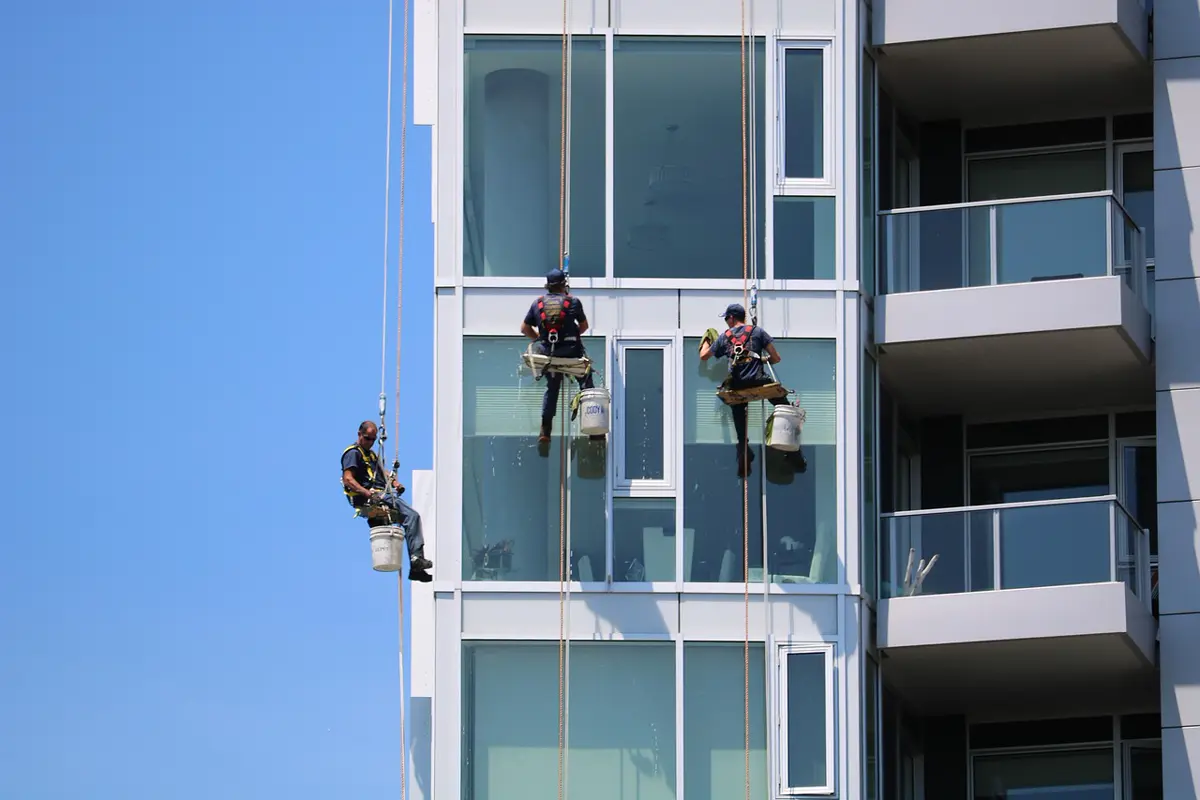
Federal rules on high work shape both your safety practices and your insurance. OSHA's guidance on its walking-working surfaces rule says rope descent systems (a seat and rope setup that lowers a worker down a building face) are used for exterior building cleaning, particularly window cleaning. The rule limits rope descent use to 300 feet above grade, with a narrow exception when no other method is feasible or safer, a limit OSHA took from the ANSI/IWCA window cleaning standard.
The rule covers roof anchors as well. A summary from Bella FSM explains that the building owner must identify, test, certify and maintain each anchorage to hold at least 5,000 pounds per attached worker, and must confirm this to the employer in writing before any rope descent system is used. The same summary points out that OSHA doesn't issue a window cleaner license.
Some states go further. Washington has its own window cleaning safety standard, WAC 296-878, covering training, rope selection, boatswain's chairs and power line clearances.
On the insurance side, what matters most is describing your work honestly. Applications usually ask about the highest floor you work on, whether you use rope access, lifts or scaffolds, and how your work splits between residential and commercial. If you start taking high-rise jobs, tell your agent before the first one. A policy written for ground-level and ladder work may not fit a business that now hangs off buildings.
Contracts, certificates and additional insured requests
Commercial clients and property managers often send a contract with insurance terms before you start. Read those terms before you sign, since they can change what you need to buy.
Certificates of insurance
A certificate of insurance (COI) is a one-page summary of your policies, limits and dates. Clients ask for it as proof. It doesn't change your coverage on its own, so a client who wants real protection will usually ask for an endorsement too.
Common contract requests
The most common request is to be named as an additional insured, which adds the client to your liability policy for claims that come from your work. Insureon notes these endorsements can affect your general liability cost. Contracts also tend to set minimum limits. MoneyGeek's cost analysis uses $1 million per occurrence and $2 million aggregate as standard, but a contract may ask for more, and an umbrella policy is one way to get there.
You may also see a waiver of subrogation, which stops your insurer from trying to recover money from the client after paying a claim. That usually takes an endorsement. Watch for indemnity or hold-harmless clauses, too. They're your promise to cover the client's losses tied to your work, and your policy may not cover everything you promise, so have an agent review broad wording. Finally, commercial clients may want a workers' comp certificate, so know your state's rule for your crew size.
Common gaps in window cleaning coverage
A lot of coverage problems trace back to work the insurer never heard about. These gaps come up often in this trade:
- Side services like gutter cleaning, pressure washing, solar panel cleaning and holiday lighting may not be covered by a policy written only for window cleaning, so list every service on your application. Pressure washing carries its own risks, covered in the guide to pressure washing business insurance.
- Damage to the glass you're cleaning can be limited. Ask how the policy handles scratches from scraper blades and damage to the exact item you're working on.
- Gear in the truck usually isn't covered by commercial auto, which protects the vehicle but not the ladders and water-fed system inside it.
- Gear kept at home may be thinly protected. The SBA notes that a homeowner's policy rider may cover only a small amount of business equipment.
- Height and method limits in some policies restrict rope access, lift work or work above a certain height. Ask about this directly.
Checklist: what to ask an agent or check in a contract
Bring this list when you talk to a licensed agent or when a client sends over a contract.
- Does the policy's business classification match all your services, including gutters, pressure washing or solar panels?
- Is there any height limit, or any exclusion for rope access, lifts, boom trucks or scaffolds?
- How does the policy treat scratched or broken glass on the job you're working on?
- Are your ladders, poles and water-fed systems covered at job sites, in your vehicle and at home?
- Does your state require workers' comp for your crew size, and can you cover yourself as the owner?
- Are your helpers employees or independent contractors under your state's rules?
- Do you need a commercial auto policy? If you use personal vehicles, do you need a hired and non-owned auto add-on (coverage for vehicles the business doesn't own)?
- What limits do your commercial contracts require, and do you need an umbrella to meet them?
- Can you add clients as additional insured, and is there a fee or a blanket option that covers all clients?
- Does the contract ask for a waiver of subrogation or primary and noncontributory wording (your policy pays before the client's)?
- Does the indemnity clause promise more than your policy covers?
- Do your residential clients expect a janitorial bond?
- How fast can you get a certificate of insurance when a new client asks?
Common questions
Do part-time window cleaners need insurance?
There is usually no general law that requires liability insurance for part-time window cleaning, but clients often ask for proof before they hire you. A single accident, like a ladder hitting a car, can cost more than a season of income. Workers' comp rules still apply if you hire help, depending on your state.
Will general liability pay for a scratched or broken client window?
Often it can, since the window belongs to someone else. But some policies limit coverage for damage to the exact property you are working on. Scratches from scraper blades can also lead to arguments about whether the damage was already there. Ask your agent how your policy handles both before you count on it.
Is a janitorial bond the same as liability insurance?
No. A janitorial bond pays a client if an employee steals from them. It does not cover accidents, injuries or property damage, and it does not protect your own business. Residential window cleaners who work inside homes are the most likely to be asked for one.
Does a personal auto or homeowner's policy cover a window cleaning business?
Not reliably. A personal auto policy may not pay for accidents while you drive for business. The SBA notes that a homeowner's rider may cover only a small amount of business equipment. Tell your insurers how you use your vehicle and home, and ask what business use is excluded.
Does high-rise or rope work need different insurance?
You need to tell your insurer about it. Applications usually ask how high you work and whether you use rope descent, lifts or scaffolds, and some policies restrict that work. High-rise jobs also come with OSHA rules on rope descent systems and roof anchors, and commercial contracts often ask for higher limits.
Sources
- Walking-Working Surfaces and Personal Fall Protection Systems Final Rule FAQ U.S. Occupational Safety and Health Administration
- Launch your business: Get business insurance U.S. Small Business Administration
- How much does window cleaning insurance cost? Insureon
- Average Window Cleaning Insurance Cost (2026 Report) MoneyGeek
- Window Cleaning Insurance: Protect Your Business The Hartford
- Window Cleaning Insurance for Liability ERGO NEXT Insurance
- What to Know About Workers' Compensation in Your State Simply Business
- OSHA Window Cleaning Requirements: 2026 Rules, Penalties, and State Breakdown Bella FSM
Prepared by the Cover for Work Editorial Team and checked against the sources above. How we write and update guides. Spot an error? Tell us.